
A useful air fryer buying guide comes down to one idea: an air fryer is a small countertop convection oven, so you are really choosing a fan, a basket and a set of controls. [1] Decide how many people you cook for and how much worktop space you can spare, then check basket size, controls and how easy the parts are to wash. Model names matter far less than those basics.
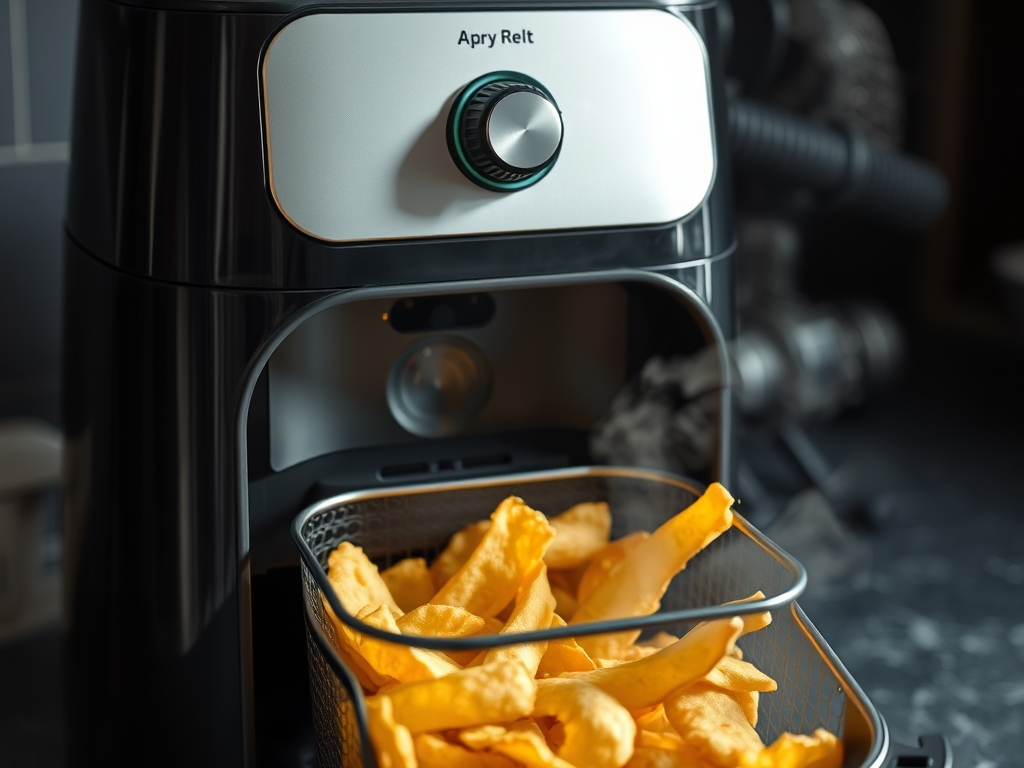
What is an air fryer actually doing to your food?
In a convection oven, a heating element surrounds a fan, and a small fan moves air through the cooking chamber. [1] The moving air thins the stationary layer of cooler air that naturally forms around food and acts as an insulator, so heat reaches the food faster and cooking is quicker. [1] Compact convection ovens made for home counters are frequently sold as air fryers, so the same cooking method appears under many names. [1]
One practical consequence: fan ovens are usually set about 20 °C lower than a non-fan oven to avoid overcooking the outside of the food before the middle is done. [1] If you are converting a favourite oven recipe, drop the temperature by roughly that amount and check earlier than you would normally.
How to choose an air fryer size
Size is the decision most people get wrong, and not because they buy too small. A bigger basket is only useful if air can still move around the food. How much food you cook at once, and whether airflow is restricted, changes how a fan oven performs — an oversized baking tray is given as an example of something that blocks airflow. [1] A crowded basket has the same problem: food steams where it should crisp.
Work through it in this order:
- How many people, most nights. Cooking for one or two is mostly about single portions and quick sides; a household of four usually wants room for a full tray of chips or vegetables in one layer rather than two batches.
- Whether you want to cook a whole joint or bird. That is a shape question as much as a volume question, so check the stated basket dimensions on the model page, not just the capacity figure.
- Worktop and cupboard space. An air fryer needs clear space around it for vents, and it is a bulky thing to store if it only comes out occasionally.
- Batch cooking. If you cook once and eat twice, a slightly larger basket is easier to live with than a small one you have to run twice.
Write your answers down before you shop. They eliminate most of the range faster than any feature list.
Which controls and features are worth paying attention to?
Most air fryers do the same job; the differences are in how you set them and how much of the machine you have to wash.
- Dial or digital. Dials are quick and easy to nudge mid-cook; digital panels usually let you set time and temperature precisely. Both work — pick the one you will actually adjust.
- Independent time and temperature. Presets are convenient, but being able to set your own time and temperature matters more once you stop following the booklet.
- A viewing window or a shake reminder. Useful if you open the basket constantly to check on things, since every opening loses heat.
- Removable, washable parts. Check the product page for exactly which parts come out and whether the manufacturer says they are dishwasher-safe — this varies by model, so do not assume.
- Non-stick care. Whatever you buy, use wooden or silicone tools and avoid abrasive sponges so the coating lasts.
What about running costs and cleaning?
An air fryer heats a small cavity rather than a full oven, and fan ovens cook faster than non-fan ovens because heat transfers more quickly. [1] That is the reasoning behind the running-cost claims you see everywhere, but the honest answer is that it depends on your model, your oven and how you use them. Check the wattage on the appliance’s rating label and in the manual, and compare it with your main oven’s — that is the only comparison that applies to your kitchen.
Cleaning is the more reliable day-to-day cost. A basket that lifts out and a tray that wipes clean will get used far more often than one that needs soaking. Look at the shape of the corners and whether the element is exposed and awkward to reach, and check the manufacturer’s cleaning instructions before you commit.
Why do so many air fryers look the same?
The design is a settled formula rather than a new invention. A fan-equipped oven was developed in 1914 but did not reach the market, while the Maxson Whirlwind Oven, the first widely adopted convection oven, came in 1945. [1] Groupe SEB launched the first air fryer in 2006 as its Actifry convection oven in France; Philips brought its Airfryer to the IFA Berlin electronics show in 2010, and by 2018 “air fryer” was becoming a generic term. [1]
UK air fryer use has grown sharply since the early 2020s; a 2024 study reported that one in five surveyed Britons named air fryers as their most-used cooking appliance. [1] That popularity explains the crowded shelves — and why you should compare on size, controls and cleaning rather than on the shape of the box.
Air fryer options available in the UK
| Brand | What they offer | Worth knowing |
|---|---|---|
| Cosori | A UK-facing site for air fryers and other kitchen appliances, presented under the banner of smart air fryers for healthy cooking. [2] | Cosori’s UK site highlights smart air fryers and kitchen appliances for healthy cooking. [2] |
Which option fits whom
If you are cooking for one or two on a small worktop, start with the smallest basket that comfortably holds a single layer of what you actually cook, and prioritise easy cleaning. Cosori’s UK site lists smart air fryers and kitchen appliances for healthy cooking. [2]
If you are already buying other home appliances from SharkNinja, it makes sense to look at its UK range for the air fryer too, since the site covers appliances and cleaning products together. [3] Check the individual product page rather than assuming every model has the same features.
If neither brand matches what you need, that is a perfectly good outcome. Size, a basket that comes apart easily and controls you understand will serve you better than a badge, and those are things you can check on any product page.
If you mainly reheat and crisp, a simple dial model with a removable tray is enough and easier to live with than a wall of presets.
If you want to replace some oven cooking, look for a model whose basket fits a whole meal’s worth in one layer, since restricted airflow is what spoils results in a crowded basket. [1]
Before ordering, confirm the current specification, capacity and care instructions on the brand’s own site, as ranges and model details change.
Sources
- Convection oven (Wikipedia) — Wikipedia
- Cosori official site — cosori.co.uk
- SharkNinja official site — sharkninja.co.uk
How we put this together: we compared these options using each brand's published product and policy pages and the references listed above. We haven't tested the products ourselves, and details such as prices and policies can change, so check the brand's site before you buy.