
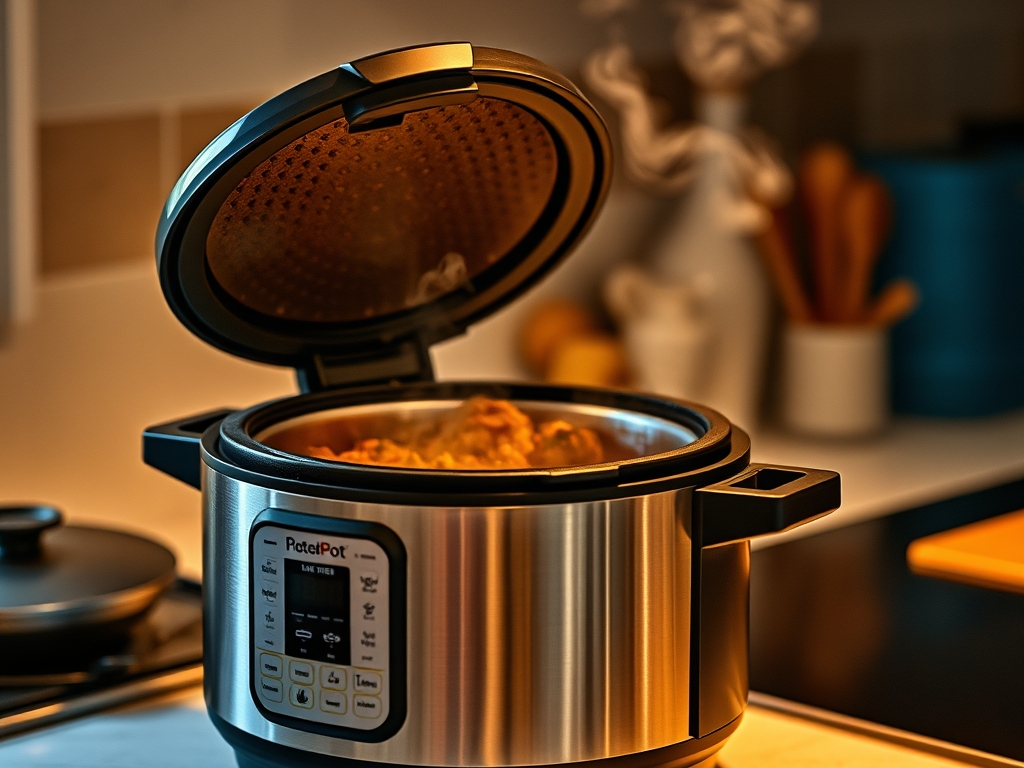
A multi cooker is an electric kitchen appliance built around an inner pot that sits over a heating element at the bottom of a larger base, with a lid and either a heat dial or a set of programmed buttons [1]. A basic model boils, simmers, fries, steams, stews and bakes [1]. Automated versions add a timer and one-touch programmes for specific dishes, so you press a button and leave the appliance to cook [1]. In practice that means one machine covering several jobs that would otherwise need a pan, a steamer and a small oven [1].
What is a multi cooker used for?
Most of the everyday cooking that normally happens in a pan or a steamer. Wikipedia says a common multicooker handles boiling, simmering, baking, frying, deep-frying, grill-roasting, stewing, steaming and browning food [1].
On automated models the programmes are built around temperature ranges, which is the most useful thing to understand before you buy:
- Cook brings the pot to the boil and holds it, roughly 90–110 °C, for soup, broth, porridge made with milk, rice and grains [1].
- Pasta boils, pauses and signals so you can add ingredients, then boils again — roughly 90–115 °C — for pasta, dumplings, eggs and sausages [1].
- Stew boils and then drops to a slightly lower temperature, roughly 85–105 °C, for vegetables, meat and seafood [1].
- Fry works with the lid open or closed at roughly 140–160 °C, for meat, poultry, fish, vegetables and seafood [1].
- Bake covers biscuits, casseroles, cake and pastries at roughly 120–180 °C [1].
- Rice/grain holds a boil until the water is gone, around 100 °C, for rice, buckwheat, peas, beans and coarse grains [1].
- Pilaf runs a full boil and then reduces the heat, roughly 90–110 °C and then 70–80 °C [1].
- Steam handles vegetables, meat, dumplings and baby food at roughly 100–115 °C [1].
- Soup covers soup, broth and drinks at roughly 90–110 °C [1].
- Yoghurt/dough holds a low temperature of roughly 35–60 °C and can prove dough for up to 12 hours [1].
Beyond the dish buttons, many models have a custom setting where you set temperature (roughly 35–180 °C), time and sometimes pressure yourself; that range is wide enough for sous-vide cooking [1]. Keep-warm often switches on automatically when a programme ends and holds food at around 70 °C or above [1]. Some models also reheat, delay cooking to a later time, or work as a slow cooker [1].
The breadth is real: multicookers can make hundreds of dishes from any cuisine, apart from those needing a type of cooking the appliance does not support, such as flame grilling [1].
What is a multi cooker pot, and how is the machine put together?
Wikipedia describes a basic multicooker as having a pot inside a larger base above a bottom heating element, a heat-setting dial, and a handled lid [1]. Some models add an adjustable thermostat on top of that [1].
It helps to see what it is not. Compared with an electric kettle, a multi cooker has a larger pot shape and higher power ratings, and it does not turn itself off automatically when the water boils [1]. Compared with a rice cooker, it is less specialised at cooking rice [1]. So if rice is the main thing you cook, a dedicated rice cooker is the more focused tool; if you want one pot for soup, stew, frying and steaming, the multi cooker is the broader one [1].
When you compare models, the practical checks are the pot’s usable capacity against the number of people you cook for, whether the inner pot lifts out for cleaning, and the appliance’s wattage — worth knowing because these appliances can carry higher power ratings than a kettle, and running cost depends on what you cook and for how long [1].
Manual, digital and pressure multi cookers: the main types
The category splits mainly by how much the appliance does on its own.
Basic manual. You set the heat level with a dial and judge the cooking yourself, much as you would on a hob [1].
Digital and automated. One button per dish, a timer, sometimes an adjustable thermostat; you pick the programme and the appliance runs it, typically without further intervention [1].
Programmable, multi-step. Wikipedia says the newest models have electronic controls for time, temperature and pressure and are sold as automated multifunction cooking devices; certain models also offer Bluetooth and Wi-Fi and can run recipe scripts that set temperature, time and pressure in several stages [1].
Pressure-capable models. Some modern cookers control pressure electronically alongside time and temperature [1], which is what buyers searching for a multi cooker with pressure cooking are looking at.
Slow-cooker crossovers. Some multi cookers can also function as slow cookers [1]. Searches for a multi cooker crock pot usually mean a slow-cooking pot, and the slow-cook function is the equivalent here [1].
Named-brand versions. Searches such as “Ninja multi cooker” or “KitchenAid multi cooker” point to one maker’s take on the category. Programmes, pot sizes and accessories differ by model, so check that maker’s own product page for the exact specification rather than assuming the programme list above carries across unchanged.
The same appliance is also called a multi cooker, and according to Wikipedia some versions are marketed as “Hot Pot” or “Electric Hot Pot” because they can prepare hot pot [1].
What a multi cooker will not replace
Two clear limits. It cannot flame-grill [1], and it is not a kettle — it will not switch itself off when water boils [1].
There is also some useful context in how the appliance arrived. Wikipedia says that in 1920s Britain, simple multicookers were sold to households as a way to use less gas [1]. Simple electric rice cookers were developed in Japan in the 1950s, and functions were added over time until the appliances became known as multicookers [1]. Meanwhile the European market had been producing single-function appliances — kettles, pressure cookers, bread makers, toasters, steamers, microwave ovens and yoghurt makers — and the multicooker combines the functions of some of those devices [1]. That is the honest way to think about the trade-off in a small UK kitchen: one appliance taking one worktop footprint, in exchange for doing several jobs reasonably rather than one job perfectly [1].
| Brand | What they offer | Worth knowing |
|---|---|---|
| De’Longhi | A UK online shop covering automatic and manual coffee machines, coffee beans and accessories, kettles and toasters, plus dehumidifiers and portable heating for the rest of the home [2] | De’Longhi’s coffee beans page lists eight products, including 100% Arabica and 70% Arabica/30% Robusta blends, with the 70/30 blend listed in a 1 kg bag and 250 g bags listed for other blends; the site’s kitchen range lists kettles and toasters alongside coffee machines, so it is a place to match the kettle-and-toaster end of a worktop rather than to buy a multicooker [3][2] |
Which option fits whom
De’Longhi suits a reader who is refreshing the whole worktop and wants the kettle, toaster and coffee side of it from one brand — its UK site presents those as the kitchen range, along with coffee beans and accessories, and dehumidifiers and portable heating for the rest of the home [2][3]. Where worktop space is the worry, the brand makes a point of compact footprints: it describes its Rivelia Start automatic coffee machine as fitting into 24.5 cm [2]. A multi cooker is not part of the kitchen range shown there [2], so plan to source that appliance elsewhere and use this brand for the pieces around it.
If a multi cooker is the only thing you are buying, the decision is really four questions: manual dial or one-touch programmes, whether you need electronic pressure control, what capacity fits your household, and whether the inner pot lifts out for washing [1]. Readers who mostly reheat and slow-cook are served by a model with keep-warm and a slow-cook function [1]; readers who want to bake and fry as well need the higher-temperature programmes [1]. If you are short of worktop and already own a rice cooker you are happy with, the multi cooker’s weakest suit is rice, so keep the rice cooker and buy for the other jobs [1].
Before ordering, confirm the current programme list, pot capacity and wattage on the brand’s own product page, since specifications vary between models and change over time.
Sources
- Multicooker (Wikipedia) — Wikipedia
- De'Longhi official site — delonghi.com
- De'Longhi: Coffee beans — delonghi.com
How we put this together: we compared these options using each brand's published product and policy pages and the references listed above. We haven't tested the products ourselves, and details such as prices and policies can change, so check the brand's site before you buy.