
Cleaning a stand mixer comes down to keeping water out of the head. Switch off and unplug, wash the bowl and bowl tools in warm soapy water, wipe the machine’s head and base with a damp cloth, and dry every part before reassembly. That routine, done after each bake, is most of the job. Here is how to clean a stand mixer properly, including the deeper clean, the parts that should never see water, and what the two big UK brands list for their own ranges.
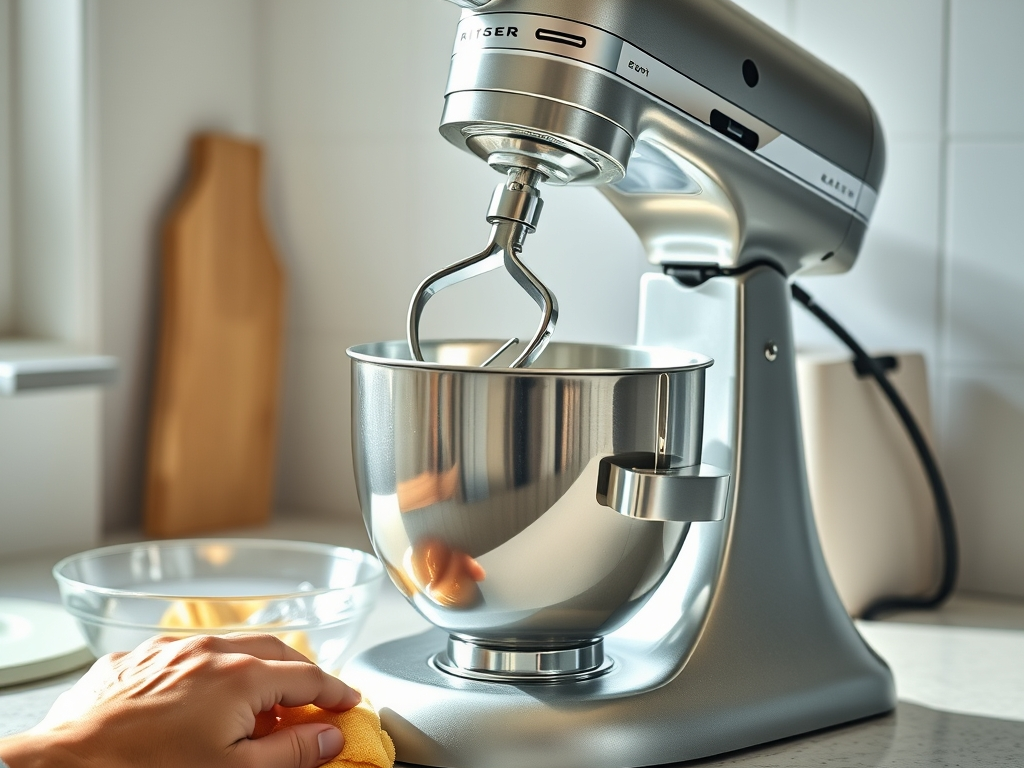
What you need before you start
- The manual for your model. Lancaster City Council’s guidance on catering machinery says to refer to the machine’s user manual because safety features and procedures vary, and notes that many manuals can be found online and downloaded free [1]. Cleaning instructions, dishwasher guidance and which parts detach all live there.
- Warm soapy water, a soft cloth, a soft brush and a dry tea towel. A clean pastry brush or bottle brush reaches flour out of the attachment hub and around the tool shaft.
- Nothing abrasive. No scouring pads, wire wool or cream cleaners on painted or brushed metal surfaces.
Why it matters: food hygiene is about protecting food from contamination and preventing organisms multiplying to a level that spoils food or puts people at risk [2]. Flour, egg and dairy left in the bowl, under the head or around the tool shaft are exactly the residues you don’t want in the next batch.
There is an allergen angle too. Coeliac UK publishes guidance on avoiding gluten cross-contamination when cooking at home [3], so if you bake gluten-free alongside ordinary bread, wash the bowl and tools thoroughly between jobs rather than wiping them out.
The after-every-bake routine
- Switch off and unplug at the wall. HSE guidance on food machinery is written for commercial kitchens, but the principle carries over: routine cleaning should be done in a way that keeps people away from unguarded moving parts [4].
- Lower the head or drop the bowl, depending on your model, then take the bowl off and remove the bowl tool — beater, whisk or dough hook.
- Scrape, don’t soak. Empty the bowl of dough or batter with a spatula before washing. Dried dough is easier to remove if you soften it with a warm damp cloth for a few minutes than if you attack it with a knife, which can scratch stainless steel.
- Wash the bowl and bowl tools in warm soapy water with a soft sponge, rinse and dry immediately with a tea towel. Drying straight away avoids water marks on brushed steel and stops the tool shaft from sitting wet.
- Wipe the head and the stand with a cloth that is damp, not wet. Pay attention to the underside of the head, the bowl cradle and the area around the speed control, where flour settles. Wipe in one direction and rinse the cloth often.
- Brush out the attachment hub port — the square socket at the front where mincers, slicers and pasta rollers slot in. Crumbs and flour collect there and are hard to shift once compacted.
- Leave it open to air for a few minutes before you put the bowl back, so any damp patches can dry rather than being sealed in.
How to deep clean a stand mixer
Every few weeks, or after a heavy bread or icing session, add these steps to the routine above.
- Work around the vents. Motor housings have slots or grilles for airflow. Don’t spray cleaner near them and don’t poke anything inside; wipe around them with a barely damp cloth.
- Clean the bowl-lift cradle or tilt hinge. On a bowl-lift machine the bowl sits on a platform that lifts; on a tilt-head machine the head pivots on a hinge at the back. Both collect flour in the crevices. A soft brush and a damp cloth handle it without dismantling anything.
- Deal with dried icing sugar and meringue. These set hard and are water-soluble, so a warm damp cloth left in contact for a few minutes does more than scrubbing.
- Wipe the cord and plug area with a dry cloth only, and check the cord isn’t trapped under the base when you put the machine back.
- Know when to stop. If the head wobbles, the machine grinds, or a part won’t come off as it used to, contact the brand’s customer care rather than taking the machine apart yourself. The manual is the reference for anything mechanical [1].
Bowls, tools and attachments: what gets washed and what gets brushed
Stainless steel bowls, balloon whisks, flat beaters and dough hooks: warm soapy water, soft sponge, rinse, dry straight away. Dough hooks need extra attention where dough packs into the spiral.
Anything coated or edged in silicone: treat it like a non-stick pan. Soft sponge only, no scouring pad, and don’t stack it against other metal tools in the sink.
Dishwasher use: check the manual or the marking on the part before loading anything. Bowl materials and finishes vary across a range, so don’t assume.
Pasta rollers and cutters: these are normally cleaned dry — brush out the flour and semolina with the brush supplied, and keep water away from the rollers. Check the leaflet that came with your attachment.
Food processor, mincer and slicer attachments: these contact raw meat, so wash them thoroughly in hot soapy water after use and again before they touch ready-to-eat food, in line with the contamination principles that underpin food hygiene guidance [2].
The machine body: never immersed, never sprayed. A damp cloth and a dry cloth.
How the two biggest UK mixer brands compare
The manual that comes with your machine is always the authority on cleaning. What the brands’ own UK sites tell you is which bowls, tools and attachments you’ll be looking after. KitchenAid and Kenwood are both sold in the UK.
| Brand | What they offer | Worth knowing |
|---|---|---|
| KitchenAid | Tilt-head and bowl-lift stand mixers with bowls listed at 4.3 L, 4.7/4.8 L and 5.6–6.6 L, and guarantees listed as 2 years or 5 years depending on model [5] | The range includes more than 15 attachments — pasta cutting, grain milling, spiralising and a food processor attachment — plus a Flex Edge beater with a silicone edge for 4.3, 4.7 and 4.8 L tilt-head mixers [6] |
| Kenwood | Stand mixers supplied with three bowl tools as standard: the K-Beater, whisk and dough tool [7] | The range spans the original Chef, Chef Baker with weighing, Titanium Chef Patissier XL with weighing and warming, Cooking Chef with weighing and cooking, kMix and Kenwood Go [8] |
Knowing which you have tells you which surfaces you can reach easily and which need a brush.
Which option fits whom
If you already own a tilt-head mixer and use the Flex Edge beater: that beater is listed for 4.3, 4.7 and 4.8 L tilt-head models and has a silicone edge [6], so keep it away from scouring pads and wash it by hand unless your manual says otherwise.
If you want the least washing up: Kenwood’s stand mixers come with three bowl tools as standard [7], which covers cakes, bread and whisking without buying extra kit.
If you like adding attachments: KitchenAid lists more than 15 across its range [6], and each one is another set of cleaning instructions to learn. Kenwood also lists attachments as part of its range [8].
If you’re still deciding and may change your mind: KitchenAid’s UK site sets out a 14-day return window through its returns portal [9], so check the terms before you unbox everything.
If worktop space is tight: measure the height before you buy. KitchenAid groups its mixers by overall height, with medium models at 35 to 40 cm and large models above 40 cm [5], and a machine that has to live on the worktop needs wiping down more often than one that goes back in a cupboard.
Whoever made your mixer, the care routine is the same: unplug, wash what comes off, wipe what doesn’t, dry everything, and keep water away from the motor housing. Confirm current model details, manuals and care instructions on the brand’s own site before you rely on them.
Sources
- Title: Machine guarding in food premises — lancaster.gov.uk
- Title: JSP 456 DCM Pt 2 Vol 3 – Ch 3 Food Safety Practices Amnd 013 — assets.publishing.service.gov.uk
- Title: Avoid Gluten Free Cross Contamination at Home | Coeliac UK — coeliac.org.uk
- Title: Food processing machinery – HSE — hse.gov.uk
- KitchenAid official site: Title: Stand Mixers | Best Food Mixer | KitchenAid UK — kitchenaid.co.uk
- KitchenAid official site — kitchenaid.co.uk
- Kenwood official site: Title: Which stand mixer is right for me? — kenwoodworld.com
- Kenwood official site — kenwoodworld.com
- KitchenAid: Returns & refunds — kitchenaid.co.uk
How we put this together: we compared these options using each brand's published product and policy pages and the references listed above. We haven't tested the products ourselves, and details such as prices and policies can change, so check the brand's site before you buy.