
Learning how to use a toaster oven comes down to two habits: matching the setting to the food, and using the shelf position that puts the food at the right distance from the element. The manual for one Russell Hobbs mini kitchen, for example, puts baking and roasting on the lower shelf supports and grilling, toasting and browning on the upper ones. [1] Everything else — air frying, reheating, cleaning — follows from those two choices.
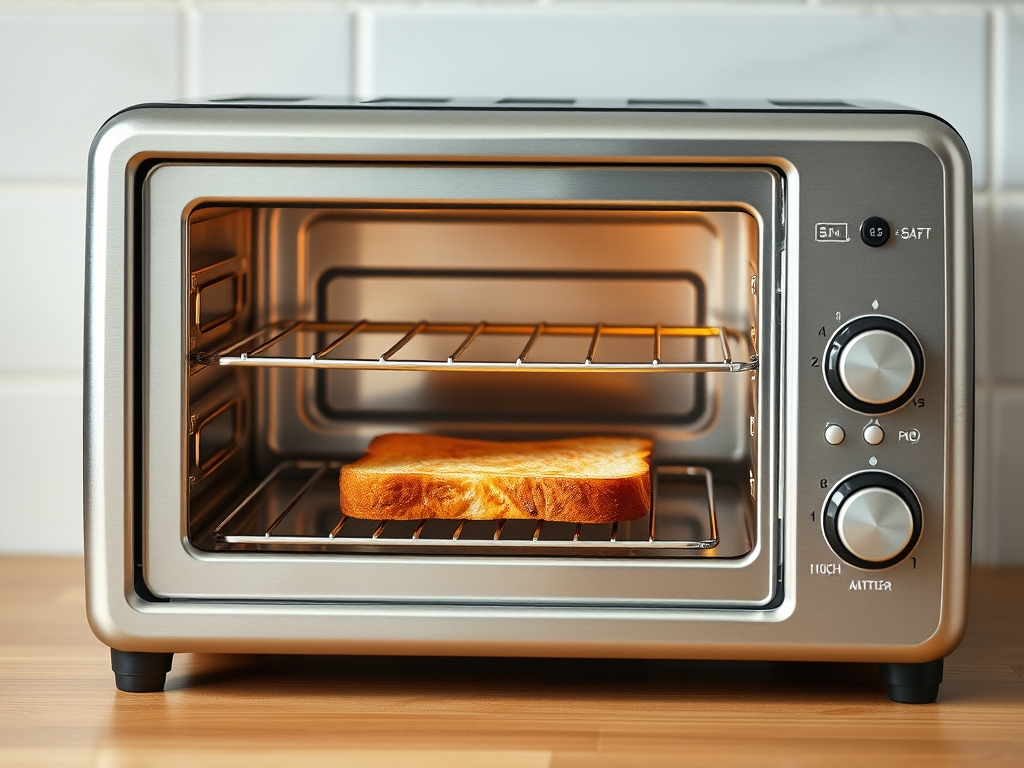
How to use a toaster oven for toast
Toast is a top-element job. In the Russell Hobbs manual the sequence is: select the upper element with the selector switch, set the temperature control to 230ºC (a lower setting is allowed) and put the food on the rack or tray on the upper shelf supports. [1]
A few practical points that follow from that:
- Keep the food clear of the element. Fat and juices can spit, and food touching the upper element is a real risk; if it happens, move the food down to a lower support position. [1]
- Watch the mess. Spitting makes cleaning harder, and residue burnt onto the top element may shorten its life. [1]
- Use oven gloves when opening and closing the door and when putting food in or taking it out, because the surfaces get hot. [1]
- Skip metal tongs. A Product Safety Report on a toaster oven model that shipped with metal tongs for lifting toast flagged an electric-shock risk from them. [2] Non-metal tongs, or gloves alone, are the safer habit.
- Turn thick slices. Because the element sits close, the surface browns before the centre has dried out. A lower shelf position and one turn mid-way suits crumpets, thick-cut bread and anything with a topping.
- Leave gaps between slices so the ones in the middle are not shielded from the heat.
Before the first use: cure the elements, check the plug, site it properly
New appliances usually need a dry burn-off before any food goes in. The Russell Hobbs manual calls this “curing” the elements: it burns off coatings left from manufacture, and it may smell and smoke a little, which the manual says is nothing to worry about provided the room is well ventilated. [1] Its own procedure is to turn the timer control anticlockwise to the 6 position and the selector to the setting for both hotplates, let them heat for about 5 minutes, then switch the selector to the oven setting, set the temperature control to 230ºC and run the timer for 20 minutes, after which the elements are cured and it does not need doing again. [1] A toaster oven without hotplates will have its own version of this in its manual — follow the maker’s timings rather than borrowing another appliance’s.
Keep the instructions with the appliance. The manual asks that you read them, keep them safe and pass them on if you pass the appliance to someone else. [1] If you live in university accommodation, the university’s accommodation pages hold a set of appliance user guides for the equipment provided in residences, which is where the model-specific instructions sit. [3]
Two checks matter more than anything else in that first session:
- The plug. A Product Safety Report on a toaster oven model BH-003 found the plug face did not meet the dimensional requirements of BS 1363 and would not make a secure connection with the socket, and that its fuse was counterfeit and did not contain a ballast — so a power surge could overheat or even explode the plug. [2] The report adds that the product failed to satisfy the Electrical Equipment (Safety) Regulations 2016 and the Plugs & Sockets (Safety) Regulations 1994. [2] Check that the plug pushes fully home with no wobble, and that the cable is undamaged — the Russell Hobbs manual says a damaged cable means returning the appliance rather than using it. [1] Buying from an established UK retailer rather than an unknown marketplace listing is the simplest protection.
- The position. Place the appliance on a firm, level surface that resists heat, no lower than 75cm above the floor, and leave at least 50mm of clearance on every side. [1] Keep it away from and never directly below combustible materials such as curtains, and do not run it through a timer or remote-control plug. [1]
Registering the appliance is worth the two minutes: Russell Hobbs offers an extra year’s guarantee if you register within 28 days of purchase. [1]
What each function is for
Most toaster ovens give you a choice of elements rather than a long list of presets, and the element you pick does most of the work.
| Setting | What it does | What to watch |
|---|---|---|
| Top element | Grilling, toasting and browning toppings; the manual’s grilling method sets the upper element at 230ºC, though a lower temperature can be selected [1] | Food spitting or touching the element — move it to a lower support position [1] |
| Bottom element | Baking and roasting from below, on the lower shelf supports [1] | Bases catching before the top colours; rotate the tray if one side browns faster |
| Both elements | General oven cooking, where the manual lets you select top, bottom or both and then set the temperature and timer [1] | Overbrowning on top in a small cavity — drop a shelf position |
| Fan or air-fry mode, if fitted | Moves hot air round the cavity so food crisps on all sides | Needs a basket or perforated tray so air reaches the underside; no fan means results closer to ordinary baking |
| Reheat | Warms plates and pastries without the sogginess a microwave gives | Dense or deep food heats unevenly; shallow dishes work better |
Whichever setting you use, slide the tray between the bottom shelf supports to catch drips when you are not cooking on the tray itself. [1]
How to use a toaster oven as an air fryer
An air-fry setting is a fan plus a basket. The Russell Hobbs manual says that if you are not cooking on the tray, you should slide it between the bottom shelf supports to catch drips. [1]
- Cook in one layer with space between pieces. Packed food steams; spaced food crisps.
- Preheat briefly. A small cavity comes to temperature quickly, and a hot start gives a better crust.
- Use a light coat of oil, not a puddle. Air does the work; oil mainly helps browning and seasoning stick.
- Shake or turn halfway through. The element is at the top, so the upper surface will always brown first.
- Keep an eye on anything light and dry — crumbs, nuts, thin bread — because the top element is close.
If the appliance has no fan, treat it as a small oven: it will still roast and crisp, just more slowly and less evenly.
How to use a toaster oven as a microwave
It is not one. A microwave heats the food itself and is the faster tool for a mug of milk, a bowl of soup or a plate of last night’s curry. A toaster oven heats from elements and hot air, so it works from the outside in — slower, but it keeps pastry crisp, melts cheese and browns a gratin in a way a microwave never will.
Practical consequences:
- Use shallow, oven-safe dishes. Deep containers brown on top while the middle stays cool.
- Do not put microwave-only plastic, tubs or cling film in it. They are not made for radiant heat.
- Reheat with both elements so the top and base warm together, and give the dish a stir or a turn if you can.
- Keep the microwave if you mostly reheat liquids and ready meals; add a toaster oven when you want texture.
Cleaning, safety and which setup suits your kitchen
Unplug the appliance before cleaning and before moving it. [1] Wipe the tray and rack as soon as they are cool enough — the Russell Hobbs manual warns that spitting makes cleaning difficult and that burnt-on residue may shorten the element’s life. [1] Keep the appliance away from baths, showers, basins and other vessels containing water, and do not use it for anything other than its described purpose. [1] Children aged 8 and above may use the appliance if they are supervised or instructed, but cleaning and user maintenance should only be carried out by children older than 8 who are supervised, and the appliance and its cable should be kept away from children under 8. [1]
Where a kitchen is shared, it helps to agree early how common items such as kitchen appliances are used and how shared spaces get cleaned. [4] A toaster oven with a tray and rack is quicker to wipe down than a grill pan, which matters when several people are using it in turn.
Matching the tool to the cook matters more than the feature list:
- Small worktop, one or two people: a compact toaster oven earns its space if you toast, grill and roast in it rather than owning a separate toaster and grill.
- Family cooking: a fan or air-fry mode and a cavity wide enough for a small roasting tin matter more than preset programmes.
- Reheating mostly: keep a microwave and treat the toaster oven as the browning and crisping tool.
- Tight budget: a simple top-and-bottom element model with a rack and tray covers toast, grilling, baking and roasting; the fan is the feature worth paying for if you want air-fry results.
Check the current manual and spec sheet on the maker’s own website before you buy. site before you buy, particularly the shelf positions, the clearance it needs and whether the plug and cable meet UK requirements.
Sources
- Title: 22780.pdf — documents.manchester.ac.uk
- Title: 2601-0204-product-safety-report-toaster-oven.pdf — assets.publishing.service.gov.uk
- Title: Appliance User Guides : Accommodation , Aberystwyth University — aber.ac.uk
- Title: Living together – Private Sector Guide — reslife.bath.ac.uk
How we put this together: we compared these options using each brand's published product and policy pages and the references listed above. We haven't tested the products ourselves, and details such as prices and policies can change, so check the brand's site before you buy.