
How does a toaster work? Mains electricity passes through a resistive heating element, often nichrome wire, and the resistance turns that current into heat — a process called Joule heating. [1][2] The element radiates heat onto the bread, browning its surface through the Maillard reaction, and a timer or a heat-sensitive strip ends the cycle and releases the toast. [1]
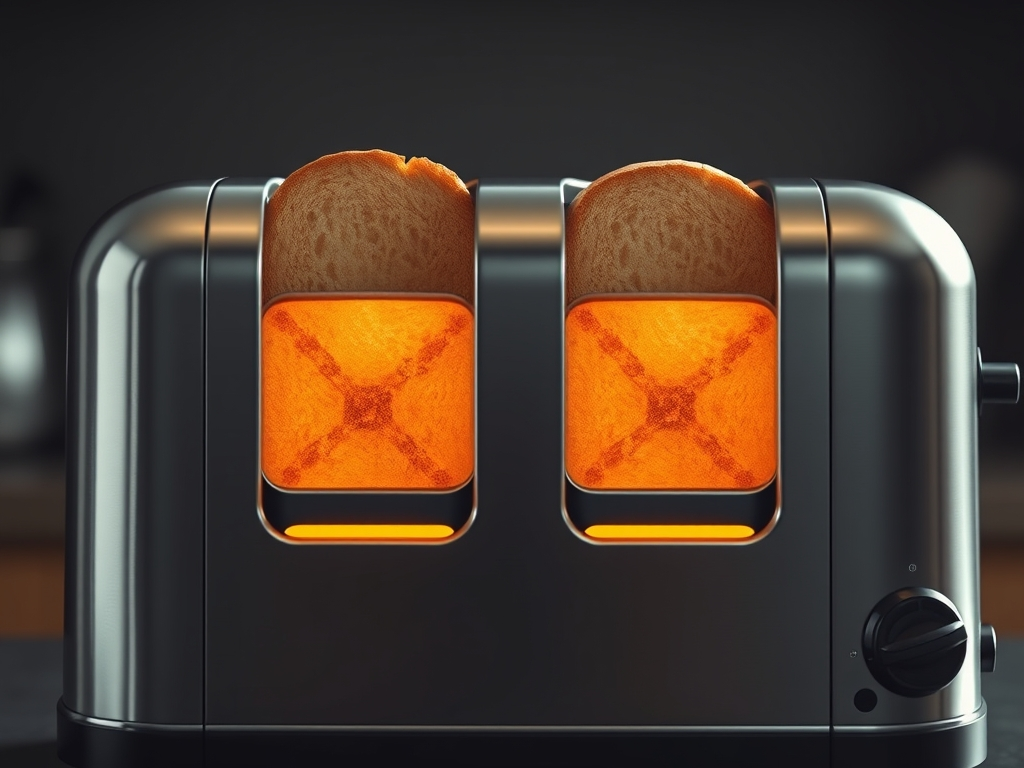
How does a toaster work, step by step?
A pop-up toaster is a simple machine with a surprisingly small number of moving parts. In order:
- The bread goes in. A single vertical slice drops into a slot at the top of the toaster, sitting between the heating elements. [1]
- You press the lever. A lever on the side lowers the bread into the toaster and activates the heating elements. [1]
- The element heats up. Current flows through a resistor and generates heat by Joule heating. [2] In many toasters the element is resistance ribbon wound around a mica card or along one of its sides. [2]
- Heat reaches the bread by radiation. The glowing element radiates heat onto the surface of the slice rather than cooking it by contact. [1]
- The surface browns. The bread browns because of the Maillard reaction, the same browning chemistry behind much of the colour and flavour in cooked food. [1]
- The cycle ends. An internal device decides the toast is done — either a timer, sometimes manually set, or a thermal sensor such as a bimetallic strip sitting close to the toast. [1]
- The toaster switches off and pops. When the cycle finishes, the appliance stops heating and the toast rises out of the slots. [1]
On a two-slot model, the lever, knob or pushbuttons on the outside set how long the cycle runs. [1]
How does the electricity in a toaster work?
The core trick is that the element is a deliberately poor conductor. Heating-element materials tend to have fairly high electrical resistivity, meaning they resist the flow of electric current well. [2] Push current through a resistor and the energy has to go somewhere, so it comes out as heat. [2]
Two consequences follow from that, and both matter when you are choosing an appliance:
- Resistance depends on the material’s shape. For a uniform piece of element material, resistance rises with length and falls with cross-sectional area. [2]
- Element performance is often described by power density — the output power divided by the heated surface area, usually expressed in watts per square millimetre or per square inch. [2] Elements with low power density tend to cost more but last longer than high power density ones. [2]
A common modern two-slice pop-up toaster uses roughly 600 to 1200 watts. [1] That figure describes the power while the element is on, not a fixed cost per slice; the energy used also depends on how long each cycle runs.
Heating elements transfer heat by conduction, convection or radiation, and they have no dependence on the direction of electrical current. [2] In a toaster the useful transfer is radiant heat onto the bread. [1]
What is the heating element made of?
Nichrome wire is the common element material in toasters. [1] The element can take several physical forms:
- Wire. Long, slender resistors with a circular cross-section, often measured by a gauge system such as American Wire Gauge. [2]
- Ribbon. Flattened round wire with a rectangular cross-section, generally between 0.3 and 4 mm wide. [2] Ribbon elements can be bent more sharply than wire and may heat up faster and cost less to make, thanks to their greater surface area relative to volume; however, ribbon often does not last as long as wire. [2] In many applications such as toasters, resistance ribbon is wound around a mica card. [2]
- Insulators. These electrically and thermally insulate the heater from the environment and foreign objects; for elements that operate above 600 °C, ceramic insulators are used, commonly aluminium oxide, silicon dioxide or magnesium oxide. [2]
How does a toaster timer work?
The dial does more than label a preference. The numbers regulate how long the bread is going to be toasted for, and once the timer has finished, the toast pops out of the top. [3] University College London explains that the dial sets how much electricity passes through the switch: a lower dial setting means a stronger current and more heat in the circuit, so the cut-off trips earlier and the bread is toasted less. [3]
In physical terms, the dial changes the resistance, which changes the rate at which a capacitor charges. [3] A capacitor stores electrical energy, usually as two metallic conducting plates separated by a non-conducting gap called an insulator. [3] When resistors and capacitors are wired together, the resistor limits the current that charges or discharges the capacitor; the capacitor builds up charge until a set voltage is reached, at which point the circuit switches off and the toast is done. [3] That is how the dial becomes a timer. [3]
Not every toaster uses a capacitor circuit. A timer or a heat sensor — for example, a bimetallic strip near the bread — can decide when toasting is finished. [1]
How does a toaster oven work?
A toaster oven is a different shape of machine. Toaster ovens, first made in 1910, are small electric ovens that can toast as well as do a limited amount of baking and broiling. [1] Like a regular oven, a toaster oven uses a small wire rack for toast or other food, but its small size lets it heat food faster than a conventional oven. [1] They are particularly handy for people who lack a kitchen stove with a built-in oven, such as those in small flats. [1]
Types of toaster compared
| Type | How it works | Worth knowing |
|---|---|---|
| Pop-up toaster | Bread drops into a vertical slot, a side lever lowers it and activates the elements, and it pops up when the cycle ends [1] | A typical modern two-slice model draws 600 to 1200 watts, and two-slice models are bought more often than four-slice ones [1] |
| Toaster oven | A small electric oven with a wire rack, invented in 1910, offering toasting plus limited baking and grilling [1] | Heats food faster than a regular oven because of its small volume [1] |
| Conveyor toaster | A belt or chain carries bread through a heated chamber, and the radiant heat per slice is set by belt speed or element output [1] | Designed for high-volume toasting in catering settings, at 250–1800+ slices an hour, though conveyor toasters have also been made for home use. [1] |
Useful extras on pop-up toasters include one-sided toasting (some people like it for bagels), heating only one slot at a time, slots in different sizes for various breads, and a way to raise bread above the usual up position so a shifted slice can be taken out safely. [1]
A simple explanation for kids
Electricity is a bit like water pushing through a narrow pipe. The thin wire inside the toaster resists the electricity, and that struggle turns into heat — the same reason a laptop charger feels warm. [2] The glowing wires don’t touch the bread much; they shine heat at it, like a very small, very bright radiator. [1] The bread’s surface browns and starts to smell like toast because of the Maillard reaction. [1] A timer keeps count and, when time is up, the spring lets the toast jump up so it doesn’t burn. [1]
Using and looking after a toaster in the UK kitchen
A few practical points come straight from handling guidance:
- The outside usually stays cool, but not the top. Many toasters have a “cool wall,” so the front, back and sides remain cool while toasting; the metal area around the slots on top is not included. [4]
- The lever only locks once plugged in. While the toaster is unplugged and cold you can check the controls and feel where to insert the bread, but the carriage lever won’t stay right down until the toaster is plugged in. [4]
- Empty the crumb tray regularly. Find where the tray is and how easily it comes out; some slide out, while others are secured by a small screw that must be turned so the tray can drop down before emptying. [4]
- Look for non-slip rubber feet underneath, to prevent unnecessary movement when it is in position and being used. [4]
- Cord storage matters on a crowded worktop. Some toasters have cord storage slots on the base, others have automatic cord rewind so the cable can be stored out of the way. [4]
- Don’t routinely toast sticky, fatty things. You can toast teacakes, toaster pastries, potato waffles and crumpets, but fat and sugar buildup inside the toaster may eventually cause it to fail. [1]
- Size it to your household. Small two-slice toasters suit making toast for one, while larger, longer toasters take four large slices and some have two carriage levers with separate browning controls so half the machine can be used independently. [4]
One last point: a toaster’s marketing and price may say little about how well it makes toast. [1] What actually determines the result is the element, the timer and how well the slot fits your bread.
Before buying, confirm the current specifications on the maker’s own website.tions and instructions on the manufacturer’s own site, since slot sizes, wattage and features vary between models.
Sources
- Toaster (Wikipedia) — Wikipedia
- Heating element (Wikipedia) — Wikipedia
- Title: What are the numbers in the toaster for? — ucl.ac.uk
- Title: Making Toast Using a Toaster – The Accessible Friends Network — tafn.org.uk
How we put this together: we compared these options using each brand's published product and policy pages and the references listed above. We haven't tested the products ourselves, and details such as prices and policies can change, so check the brand's site before you buy.
You may also find Stand Mixer Buying Guide: What to Check First and Do I need a coffee machine? Match it to your habits useful.