
Before you buy a stand mixer, work out four things: whether a tilt-head or bowl-lift design suits your worktop, what bowl capacity matches your usual batch sizes, how tall and heavy the machine is, and what comes in the box — bowl tools, attachments, guarantee and return window. This stand mixer buying guide takes each in turn, using the manufacturers’ own published specifications, so you can judge any model rather than only the two best-known names.
Tilt-head or bowl-lift: the first fork in the road
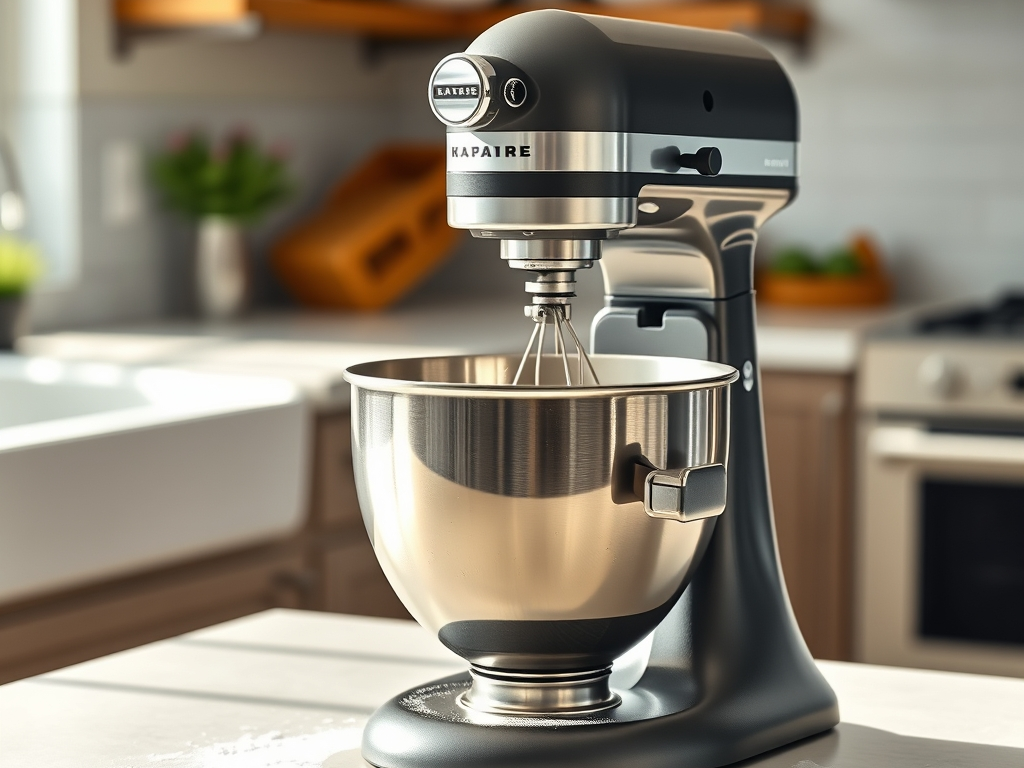
A tilt-head mixer has a head that tips back so you can lift the bowl out and scrape down the sides; a bowl-lift mixer keeps the head fixed and raises the bowl into the tools on a lever. Both do the same jobs, but the second type tends to be the one used for bigger bowls, which matters if you regularly mix large batches.
KitchenAid sells both types and lists them as separate filter categories on its UK mixer pages [1]. Its bowl-lift models in the current range include a 5.6-litre Artisan, while the 4.7-litre Artisan and Artisan Plus are tilt-head [1].
Height is the detail people forget. KitchenAid sorts its mixers into medium (35 to 40 cm overall height) and large (above 40 cm) [1]. Measure the clearance under your wall cupboards and check there is room for the head to tilt back if you choose a tilt-head model — a machine that has to live on the worktop needs to fit there permanently.
Match the bowl, motor and tools to what you actually mix
KitchenAid’s mixer range spans bowls from 4.3 litres up to 6.9 litres, with steps at 4.7 and 4.8 litres and 5.6 to 6.6 litres [1]. Its filters also split models by motor power, under 300 W or above 300 W [1].
Kenwood takes a different approach, giving its models names that describe the extra job they do beyond mixing — for example the Cooking Chef (weighing and cooking), the Titanium Chef Patissier XL (weighing and warming), the Titanium Chef Baker (weighing), plus the original Chef, Kenwood Go and kMix [2]. All Kenwood stand mixers come with three bowl tools as standard — the K-Beater, whisk and dough tool [2]. According to Kenwood, that means the mixers can handle cake, biscuit, icing and filling making, bread, pizza and pasta doughs, and whisking eggs, cream, mousses and meringues [2].
If bread is the main reason you want a stand mixer, look at how the maker describes dough work rather than only the headline wattage. Kenwood says some of its models can prove dough as well as mix it [2], which is a feature you either use weekly or never.
What is in the box, and what you add later
Bowl tools are the baseline; attachments are where the extra spending usually happens, so it is worth knowing what each brand includes and what is bought separately.
KitchenAid says it offers more than 15 attachments, including a food processor attachment that fits all its mixers to slice, dice, shred and julienne, a meat grinder and sausage stuffer set, and a vegetable slicer and shredder [3]. Some parts are mixer-specific: the Flex Edge beater is made for medium tilt-head mixers with 4.3, 4.7 or 4.8-litre bowls [3]. KitchenAid also sells personalised mixers, with the Artisan By You model offered in a range of colours with optional engraving [3].
Kenwood sells a range of optional attachments alongside its stand mixers [2], and its current line-up includes models with built-in weighing, warming or cooking functions rather than attachments alone [2]. If those functions are the reason you are upgrading, check which model carries them before comparing anything else, because the names are similar.
Space, weight and cleaning
A stand mixer is a permanent worktop appliance for most kitchens, so weight and cleaning matter as much as mixing performance.
KitchenAid lists net weights of 7 kg to 13 kg, with some models above 13 kg [1]. Lifting a machine of that weight in and out of a cupboard every time you bake gets old quickly; if you have limited worktop space, measure the footprint and height first and decide where it will live.
A baking-equipment guide from One Education suggests thinking about storage space before buying large appliances and choosing equipment that is easy to wash and maintain, such as dishwasher-safe parts [4]. The same guide treats a stand mixer as a step up from basic hand tools, worth adding as your baking develops rather than a first purchase [4].
The National Rheumatoid Arthritis Society notes that an electric mixer makes whisking easier when grip is a problem [5], which is another argument for leaving the machine out on the worktop where you can use it without lifting it.
Guarantee, returns and buying in the UK
Guarantee length varies by model, not just by brand, so check the individual product page. KitchenAid lists guarantee options of 2 years and 5 years across its mixer range [1]. Its UK returns process allows a return through a portal within 14 days, with a prepaid label or a home pickup for heavy appliances, a quality check that usually takes 3 to 5 business days after arrival, and a refund issued to the original payment method within 5 to 10 business days [6].
Kenwood was established in 1947 [7], and the Science Museum describes the Kenwood Chef as an iconic food mixer that came to dominate 20th-century home cooking [8]. Kenwood also runs a Help Me Choose quiz on its site if you cannot decide between its models [7].
Before ordering, confirm three things on the brand’s own site: the exact model number, the bowl capacity and dimensions, and the guarantee terms for that model. Model names and suffixes change, and the specification that matters is the one on the page for the machine you are buying.
Stand mixers side by side
| Brand | What they offer | Worth knowing |
|---|---|---|
| KitchenAid | Tilt-head and bowl-lift stand mixers with bowls from 4.3 to 6.9 litres, sorted by overall height (35 to 40 cm, or above 40 cm) and by motor power under or above 300 W [1] | Net weights run from 7 kg to over 13 kg, and guarantees are listed as 2 or 5 years depending on the model [1]; more than 15 attachments include a food processor, meat grinder and vegetable slicer [3] |
| Kenwood | Stand mixers sold as Cooking Chef, Titanium Chef Patissier XL, Titanium Chef Baker, the original Chef, Kenwood Go and kMix, each with K-Beater, whisk and dough tool as standard [2] | Models add specialist functions such as weighing, warming or cooking, and some can prove dough [2]; the brand has been making mixers since 1947 [7] |
Which option fits whom
You bake bread more than cake. Look at dough capability first. Kenwood states that all its stand mixers include a dough tool and that some models can prove dough [2]. On the KitchenAid side, compare models by motor power band and bowl size before anything else [1].
You want one machine to do more than mix. KitchenAid’s attachment range covers food processing, mincing and spiralising, but the attachments are separate products [3]. Kenwood builds functions such as weighing and warming into particular models [2], so the work is done by the mixer itself rather than an add-on.
Your worktop is tight. Check height and weight before buying, not after. KitchenAid publishes both, with medium models at 35 to 40 cm and large ones above 40 cm, and weights starting at 7 kg [1].
You want a colour or a personalised machine. KitchenAid offers a rainbow of colours and optional engraving on its Artisan By You mixer [3].
You are not sure you will use it enough. The One Education guide lists a stand mixer among the tools to add as experience grows, after basics such as mixing bowls, a whisk and a hand mixer [4]. If you bake only occasionally, a hand mixer plus a good bowl may cover the same ground with less worktop committed.
A ranked list of mixers tells you very little about whether a machine fits under your cupboards or whether its bowl suits a two-person household; the measurements and the bowl tools do. Confirm current specifications, guarantee terms and return arrangements on the brand’s own site before you order.
Sources
- KitchenAid official site: Title: Stand Mixers | Best Food Mixer | KitchenAid UK — kitchenaid.co.uk
- Kenwood official site: Title: Which stand mixer is right for me? — kenwoodworld.com
- KitchenAid official site — kitchenaid.co.uk
- Title: A Complete List of Cake Baking Equipment that Every Baker Needs — oneeducation.org.uk
- Title: Useful tips | NRAS | Day-to-Day Living | Practical Help — nras.org.uk
- KitchenAid: Returns & refunds — kitchenaid.co.uk
- Kenwood official site — kenwoodworld.com
- Title: Home cooking: From Victorian tech to Kenwood Chef | Science Museum — sciencemuseum.org.uk
How we put this together: we compared these options using each brand's published product and policy pages and the references listed above. We haven't tested the products ourselves, and details such as prices and policies can change, so check the brand's site before you buy.
You may also find Coffee machine buying guide: how to choose useful.